







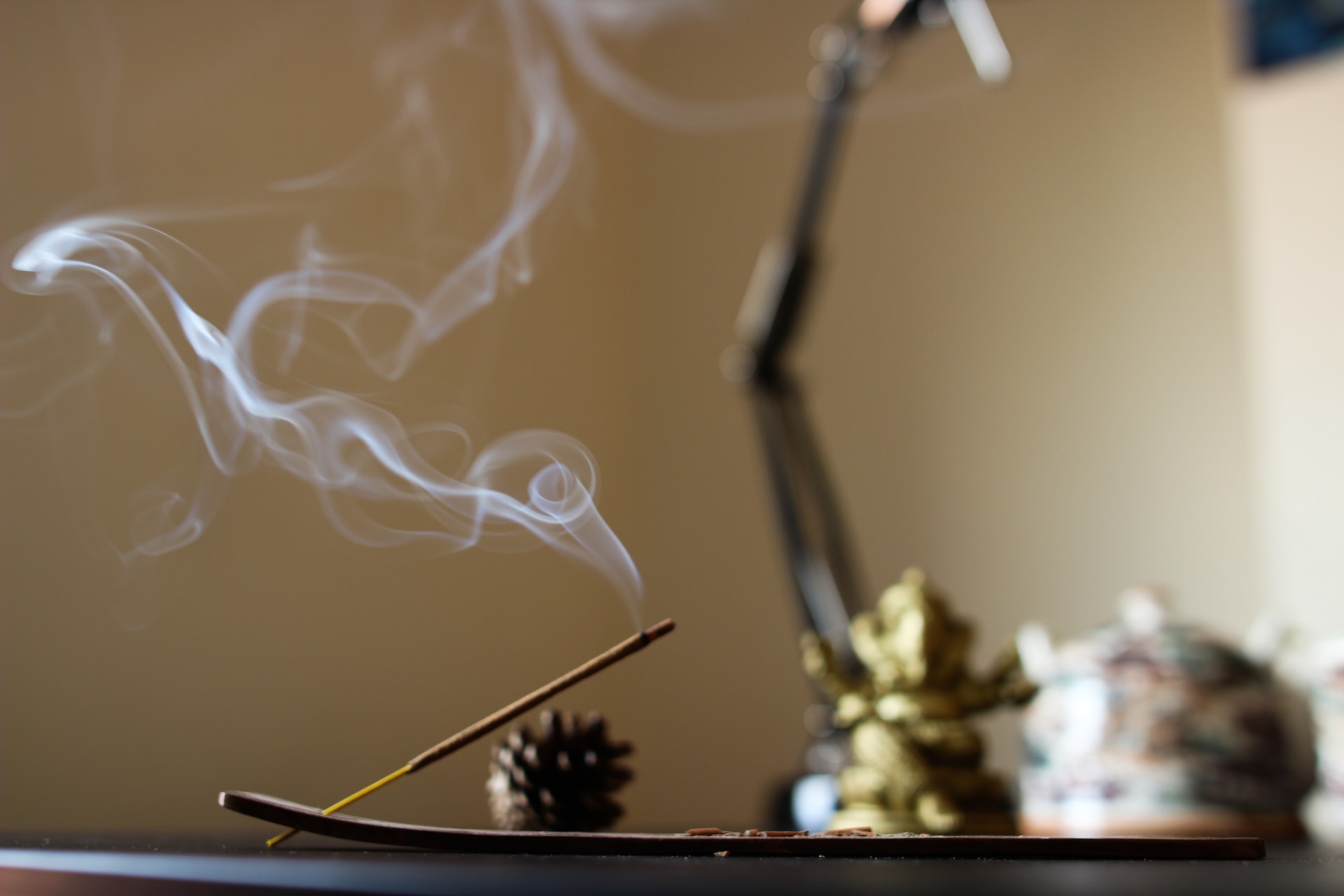
Natural incense means plant materials such as resins, dried herbs, bark and wood that release their scent under heat or embers. The most important distinction is simple: in natural incense it is the plant itself that smells, while in a typical scented stick it is a fragrance composition applied to a neutral carrier. The first is a piece of forest, meadow or desert. The second is a perfume that burns.
How does natural incense differ from ordinary scented sticks?
In many cheap sticks the core is a bamboo splint coated with wood dust and a binder, and the whole thing is dipped in a fragrance composition. Such a product can smell of rose, vanilla or "ocean", even though none of these plants ever came near it. This is not a deception in itself, just a completely different category of product.
Natural incense comes in several forms:
- resin in grains, for example olibanum or copal, heated on a charcoal disc or a mesh burner;
- dried herbs, loose or tied into bundles;
- aromatic wood, such as palo santo or sandalwood, in pieces or shavings;
- formed incense, that is cones and sticks without a bamboo core, bound from ground plants. In the Japanese tradition the binder is powder from the bark of Machilus thunbergii, called makko, and in Indian masala-type sticks it is often halmaddi resin from the Ailanthus triphysa tree.
Which plants is natural incense made from?
Resins from warm countries
Olibanum, or frankincense, is the dried sap of trees of the genus Boswellia, above all Boswellia sacra from Oman and Yemen and Boswellia serrata from India. It smells bright, lemony and balsamic. Myrrh comes from Commiphora myrrha shrubs and has a bitter, earthy note, slightly medicinal in the old, apothecary sense of the word. Benzoin, the resin of Styrax trees from Southeast Asia, recalls vanilla and caramel. Copal, prized by the Maya and the Aztecs, comes from trees of tropical America, including the genera Protium and Bursera, and smells sweet and resinous with a hint of citrus.
Plants from our own landscape
The European forest gives its own incense. The resin of Scots pine (Pinus sylvestris) and fir smells fresh and green thanks to terpenes, mainly pinenes. Common juniper (Juniperus communis) gives a sharp, clean smoke. Mugwort (Artemisia vulgaris) has a bitterish, herbal scent. To these add wild thyme, wormwood and St John's wort, plants well known from country bouquets.
Aromatic woods
Palo santo (Bursera graveolens) grows in the dry forests of Ecuador and Peru. White sandalwood (Santalum album) has accompanied Hindu and Buddhist practices for centuries. The rarest is agarwood from Aquilaria trees, called jinkō in Japan.
Where does the custom of smudging the home come from in Poland?
Smudging is not an exotic import in Poland. On the Feast of the Assumption, 15 August, bouquets of mugwort, wormwood, yarrow, wild thyme and ears of grain were blessed. The dried herbs were kept behind holy pictures, and during a storm, on Christmas Eve or at important family events a handful was thrown onto the embers. Juniper twigs were burned in rooms and cowsheds. Such rites were described by Oskar Kolberg in his monumental work "Lud".
It is interesting to set this beside Japan, where the art of kōdō, "the way of incense", developed. There a scent is said to be listened to (monkō), not smelled. Two distant cultures arrived at a similar intuition: the smoke and scent of a plant invite attentiveness and separate ordinary time from special time.
How to tell that incense is truly natural
A few simple observations say more than advertising slogans:
- Latin name and origin. A good seller will give the species, for example Boswellia sacra, and the region of harvest. "Oriental incense" on its own says little.
- Scent before lighting. A grain of resin smells subtle; only warmth "opens" it. A stick that fills the whole room with scent through a closed package usually owes this to a fragrance composition.
- Appearance. Natural resin has irregular grains of different shades and can be slightly sticky to the touch. Dried herbs show visible leaves and stems.
- Behaviour in heat. Good resin first softens and gives off vapour, and only later darkens. The scent is brightest at the beginning.
You will find descriptions of the materials we use in our aromatherapy and natural incense section.
Which natural incense to choose with nature in mind?
The popularity of some plants affects their populations. White sage (Salvia apiana) grows wild in a small area of California and northern Mexico, and mass harvesting meets opposition from the Indigenous communities for whom it is a sacred plant. Agarwood is listed in Appendix II of the CITES convention, which means its trade is controlled. White sandalwood has the status of a vulnerable species on the IUCN Red List.
A good answer is often to reach for local plants. Mugwort, juniper and pine resin grow abundantly, and their scent is part of our own tradition. With palo santo it is worth asking about the source: responsible suppliers use dead branches and fallen trees, because the aroma matures in the wood only after years of lying on the ground.
How to store natural incense so it keeps its scent
Volatile aroma compounds escape over time, and light and heat speed up oxidation. Resins are best kept in an airtight glass jar in a cool, dark place. Dried herbs like paper bags or boxes that do not trap moisture. Aromatic wood keeps its scent for years if it is not left in the sun. It is worth labelling the jar with the name of the plant and the date of purchase, because after a year the same resin already smells different.
Is the smoke of natural incense neutral for the home?
Natural does not mean smokeless. Burning any plant matter produces fine dust and volatile organic compounds, as scientific reviews of incense smoke remind us. That is why traditions around the world burn incense briefly, in small amounts and in an airy place. Heating resin on a mesh burner gives less smoke than burning it on a glowing charcoal. Incense is traditionally used as part of calming and ordering a space. Its value lies in its scent, in focus and in contact with the plant.
If you want to widen your home practice with other gifts of the forest, take a look at our natural incense. You will find there, among others, myrrh, copal and palo santo. We write more about white sage in our article white sage and the smudging ritual, and about myrrh in myrrh: the bitter resin.
If you have sensitive airways, are pregnant, or have small children or pets at home, burn incense gently and air the room, and if in doubt, consult a doctor.
FAQ: common questions about natural incense
Can natural incense be lit like an ordinary stick?
Formed incense, that is cones and sticks without a bamboo core, yes. Resins and most woods need a source of heat, for example a burner with a mesh or a charcoal disc.
How does olibanum differ from church incense?
Olibanum is the main ingredient of liturgical incense, but church blends often also contain myrrh, benzoin or other resins.
Can I gather pine resin myself?
Hardened drops from a tree's natural wounds have been gathered for generations. You must not cut into trunks, however, and in state forests there are rules on collecting forest materials.
Why does the same incense sometimes smell better and sometimes worse?
Temperature decides. With gentle heat the lightest, brightest notes are released. With strong embers the resin scorches and the scent becomes heavy and tarry.
Sources
- Langenheim J.H., Plant Resins: Chemistry, Evolution, Ecology, and Ethnobotany, Timber Press, 2003.
- Lin T.C., Krishnaswamy G., Chi D.S., "Incense smoke: clinical, structural and molecular effects on airway disease", Clinical and Molecular Allergy, 2008.
- ISO 9235:2021, Aromatic natural raw materials: Vocabulary.
- CITES, Appendix II, entries for the genera Aquilaria and Gyrinops (agarwood).
- European Pharmacopoeia (Ph. Eur.), monograph "Indian frankincense" (Olibanum indicum).
- Kolberg O., Lud. Jego zwyczaje, sposób życia, mowa, podania, przysłowia, obrzędy..., volumes published from 1857.