








White sage (Salvia apiana) is a perennial, silvery-white shrub of the mint family, growing wild in southern California and the north of the Baja California peninsula. Its dried leaves, tied into bundles and smouldered, have for generations been used by some Indigenous peoples of this region for smoke cleansing, known in English as smudging. The key distinction is simple: white sage is not the same plant as common sage (Salvia officinalis) from our gardens, and smudging is not a universal rite of "all Native Americans", but the practice of particular cultures, worth getting to know before you light your first bundle.
Who really used white sage?
Many popular texts say that white sage was used by the Navajo, Lakota or Cherokee. That is a simplification. Salvia apiana grows naturally in a relatively small area of the coastal and foothill scrub of southern California. The plant is connected above all with the peoples of that area, such as the Cahuilla, Chumash, Kumeyaay and Tongva. Accounts gathered by ethnobotanists describe its leaves and seeds in food, in infusions, in sweat lodges and in smudging.
The peoples of the Great Plains, associated in popular culture with "burning sage", usually reached for other plants. So-called prairie sage is in fact a wormwood (Artemisia ludoviciana), a relative of our common mugwort. To this were added sweetgrass, cedar and juniper. The English word sage therefore covers several entirely different plants, and translations often blur this.
What smudging means
In the traditions that practise it, cleansing with smoke is not an "aromatic" treatment. It is a prayer and a gesture of preparation: before a ceremony, after illness or mourning, when welcoming guests. The smoke is treated as a carrier of intention, and the plant itself as a living being from which one takes and which one thanks. The details of the rites belong to the communities and are often not meant for outsiders. That is why it is more accurate to say that at home we practise our own smudging ritual inspired by this tradition than that we are recreating an Indigenous ceremony.
Smudging with herbs in Polish and European tradition
We do not need to look far to find a similar gesture. In the Polish countryside, herbs blessed on 15 August, the Feast of the Assumption, were kept all year. During a storm a handful was thrown into the stove, and they were used to smudge the sick, the livestock and the farmstead. Among them were mugwort, wormwood, tansy, juniper and wild thyme. Juniper was used to smudge rooms in winter, and the smoke of its twigs was credited with the power to drive away evil. The same intuition, that the smoke of chosen plants puts a space in order and marks a boundary between what was and what is coming, can be found in many cultures of Europe.
Being aware of this kinship helps us approach white sage without exoticising it. We can value it as a plant from a distant tradition while remembering that our own herbs have an equally deep history.
What botany and science say
The leaves of Salvia apiana are rich in essential oil dominated by 1,8-cineole (eucalyptol), alongside camphor and pinenes. These compounds are responsible for the sharp, resinous-herbal, slightly camphoraceous scent. The leaves also contain diterpenes, including carnosic acid, also known from rosemary and common sage.
Laboratory studies show that extracts and oil of white sage inhibit the growth of some microorganisms in vitro. A 2007 study by Indian scientists, published in the Journal of Ethnopharmacology, is also interesting. Nautiyal's team studied the smoke of a traditional mixture of herbs and wood that is burned in India during the havan rite. In a closed room the smoke reduced the number of airborne bacteria by more than 90 percent within an hour, and the effect was still visible the next day. It was not white sage, but the study beautifully shows that the custom of smudging the home, present in so many cultures, has its counterpart in the laboratory.
Burning any plant matter produces fine particulate matter. That is why you should always air the room, not smudge near small children, birds and other pets, and if you have asthma or sensitive airways, consider just keeping a dried bundle nearby, or a brief, symbolic smoulder by an open window, instead of smoke.
Ethics: where your bundle comes from
The worldwide popularity of white sage has its price. In California there have been cases of illegal harvesting from wild stands, sometimes by the sackful, on protected land. Representatives of Indigenous communities point out that a plant which is sacred to them is becoming a mass commodity, while at the same time it is harder for them to gather it for their own ceremonies. United Plant Savers, an organisation dedicated to protecting wild medicinal plants, has placed white sage on its list of species to watch.
What follows from this in practice? Choose cultivated sage rather than wild-harvested, and ask the seller about its origin. Use it sparingly: with sensible smouldering, one bundle is enough for many rituals. And when you want to smudge often, sometimes reach for native plants such as mugwort or juniper.
How to read a bundle's description before buying
- The Latin name. Look for Salvia apiana. If the description says only "sage", it may be a different plant.
- Origin. Information about cultivation is better than no information or "wild-harvested".
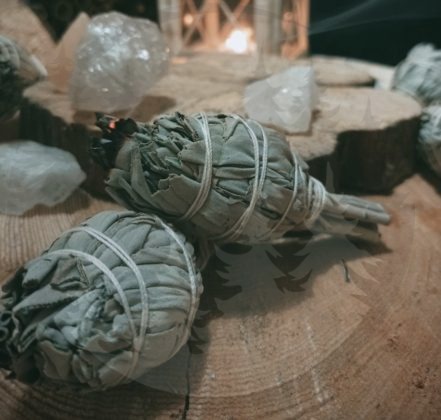
- Appearance. The leaves should be silvery-grey to greenish, dry, without mould and without dyes. Overly bright colours or added glitter are decoration, not herb.
- Scent. Distinct, clean, camphoraceous and resinous. A musty smell points to poor drying.
At Las Szamana we put our trust in a transparent description of origin. If you want to see what a well-tied bundle looks like, take a look at our White Sage (Salvia apiana).
A home smudging ritual: morning and evening
A ritual does not need many words. Rhythm, however, helps. A simple division into morning and evening makes smudging a conscious transition rather than a reflex.
Morning: opening the day
- Open the window and for a moment simply breathe the fresh air.
- Light the tip of the bundle and after a few seconds blow out the flame, so that the leaves only smoulder.
- Hold a heat-proof bowl, a shell or a ceramic dish underneath to catch the embers.
- Walk calmly through the room you will work in. Think in one sentence about what you want from this day.
- A minute or two is enough. Put out the bundle by pressing it into sand or ceramic, never with water, because damp leaves go mouldy.
Evening: closing the day
- In the evening smudging serves to set aside what has passed. It works well after a difficult conversation, after having guests or simply at the end of work at the computer.
- Start at the front door, then move through the rooms, pausing in the corners where we usually leave things "for later".
- At the end you can gently move the smoke around yourself, from feet to head, and thank the plant.
- Air the room thoroughly before going to sleep. The bedroom should be free of smoke.
Never leave a smouldering bundle unattended, and keep it away from curtains, paper and dried flowers. Also check whether there is a smoke detector nearby that might go off.
With respect for the plant and for people
White sage teaches attentiveness on two levels. The first is the ritual itself: pausing, the scent, smoke rising towards the window. The second is the awareness that we are holding a plant from a particular place on Earth, important to particular people. When we join these two levels, smudging stops being a fashion and becomes a quiet gesture of gratitude. And that is exactly what we wish everyone who reaches for this bundle.
Sources
- Moerman, D. E. Native American Ethnobotany. Timber Press, 1998. A compendium of plant uses by the Indigenous peoples of North America, including Salvia apiana and Artemisia ludoviciana.
- Jepson eFlora, University and Jepson Herbaria, University of California, Berkeley. Description of the taxon Salvia apiana Jeps. and its range in California.
- Plants of the World Online, Royal Botanic Gardens, Kew. Entry for Salvia apiana: taxonomy and natural distribution.
- United Plant Savers, Species At-Risk List. A list of wild medicinal plants in need of protection, including white sage.
- Nautiyal, C. S., Chauhan, P. S., Nene, Y. L. (2007). Medicinal smoke reduces airborne bacteria. Journal of Ethnopharmacology, 114(3), 446-451.
- World Health Organization. WHO Guidelines for Indoor Air Quality: Household Fuel Combustion, 2014. Context on particulate matter from burning organic material indoors.
- Kolberg, O. Lud. Jego zwyczaje, sposób życia, mowa, podania, przysłowia, obrzędy, gusła, zabawy, pieśni, muzyka i tańce (19th century). Descriptions of Polish customs connected with blessed herbs and smudging.