






Myrrh is a dried gum resin, the hardened sap of trees and shrubs of the genus Commiphora, above all Commiphora myrrha of the torchwood family (Burseraceae). The most important difference our customers ask about: myrrh is not the same as olibanum. Olibanum, commonly called frankincense, comes from the frankincense tree (Boswellia) and smells bright and citrusy. Myrrh is darker, bitter in its note, earthy and balsamic. The two resins often meet in one vessel, but they have completely different characters.
Which tree does myrrh come from and where is it harvested?
The myrrh tree is a low, thorny tree with twisted branches, adapted to dry, stony slopes. It grows in the Horn of Africa (Somalia, Ethiopia, northern Kenya) and in the south of the Arabian Peninsula, mainly in Yemen and Oman. The trade also offers resins of related species, for example Commiphora guidottii, the source of opopanax, called sweet myrrh, as well as various kinds known collectively as bdellium.
The resin flows from the bark by itself at small cracks, but for centuries harvesters have made shallow cuts to increase the yield. The sap is at first pale and sticky; in the sun it hardens and darkens to a colour ranging from honey to reddish brown. Harvesting is manual work, often family work, carried out by herders and nomadic communities for whom resins have been a livelihood for generations.
Why does myrrh smell bitter rather than sweet?
The name itself gives away the character of this resin. It comes from the Semitic languages, in which the root murr means bitterness. Myrrh consists of three main parts: water-soluble gum, resin and a small amount of essential oil. It is the oil that is responsible for the scent.
Botanists and chemists point to a particular group of compounds in it: furanosesquiterpenes, such as curzerene and furanoeudesma-1,3-diene. They give the characteristic dark note that people describe as the smell of damp earth, old wood, roots and a touch of spice. Olibanum contains more light, volatile terpenes, which is why it smells fresh and bright. Myrrh smells more like the cellar of an old monastery than like lemon peel.
What path did myrrh take from Punt to the churches of Europe?
The ancient Egyptians brought myrrh from the legendary land of Punt. An expedition for resins and whole saplings was commemorated in the reliefs of Queen Hatshepsut's temple at Deir el-Bahari. Myrrh went into the kyphi incense burned in temples in the evening, and also into the embalming of the dead, which gave it the meaning of a gift for those who depart.
The incense route across Arabia made myrrh a commodity more valuable than many metals. It appears many times in the Bible: in the Song of Songs as the fragrance of love, and in the Gospel of Matthew as one of the three gifts of the Magi. In Eastern Christianity myrrh is part of liturgical incense, and its name is also carried by holy myron, an anointing oil prepared from many fragrant ingredients.
In Poland myrrh lives above all in the customs of the Epiphany. On the sixth of January chalk and incense are blessed in churches, and carols repeat the formula of gold, myrrh and frankincense. In Podlasie, in Orthodox churches, the dark, warm scent of myrrh is a constant part of the services. This is our European part of the story of this African resin.
How to recognise good myrrh in grains
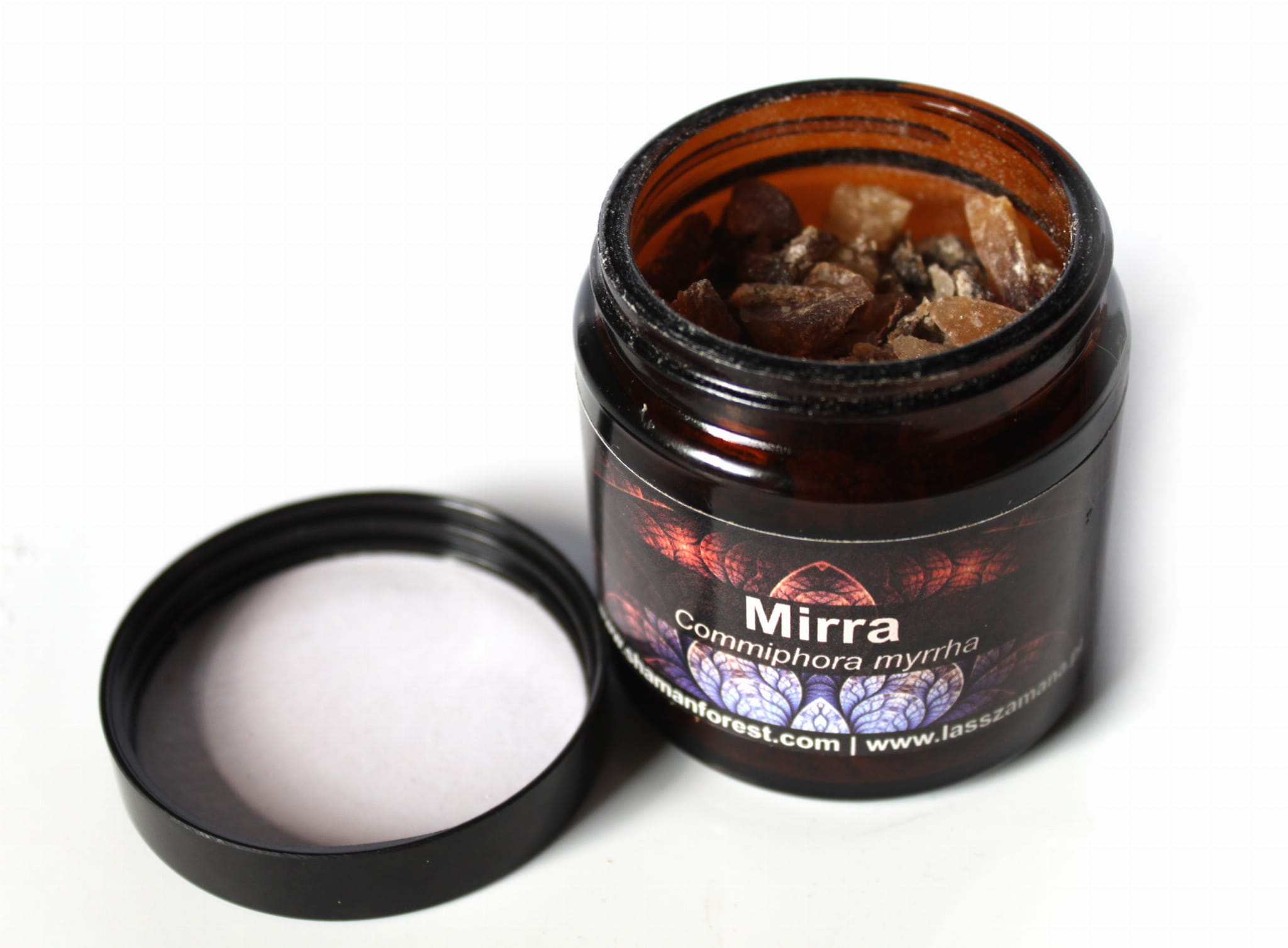
Good myrrh does not have to look perfect. It is worth paying attention to a few features that tell you about its freshness and origin:
- Colour: from amber to reddish brown. Grains can be matte and covered with a pale, powdery bloom, which is dried gum, not dirt.
- Break: when broken, a grain reveals an oily, slightly translucent interior, often with lighter streaks.
- Cold scent: delicate but distinct. A grain warmed in the hand begins to smell more strongly, balsamic and bitter.
- Behaviour in heat: myrrh tends to soften and slowly melt rather than burn with a bright flame. The smoke is dense and darker in its note than with olibanum.
- Species name: a good seller gives the Latin name of the plant and the country of origin, so you know whether it is Commiphora myrrha or the sweeter opopanax.
In our shop you will find myrrh that we choose with particular care, with a description of its origin and species.
How is myrrh traditionally burned at home?
Myrrh is most often burned on a glowing incense charcoal placed in a heat-proof vessel on a layer of sand or fine gravel. A few grains the size of a lentil are enough, because the scent is intense and lingers in the room for a long time. An alternative is a burner with a small mesh, on which the resin warms slowly and releases its aroma without dense smoke.
In many traditions myrrh rarely appears alone. It is combined with olibanum to brighten its dark character, or with conifer resins, which add forest freshness. Good companions here are copal and palo santo, as well as other natural incense from our shelf, from which you can compose your own blends.
A few common-sense rules: burn incense in a ventilated room, do not leave embers unattended, and keep the vessel away from children, animals and fabrics. Smoke is smoke, even when it smells beautiful. In rites myrrh accompanies moments of focus, prayer and remembrance of loved ones, and it is in this spirit that it deserves to be treated.
How to store myrrh resin so it keeps its scent
The main enemies of myrrh are heat and air. The essential oil that carries the scent evaporates over time, and the gum attracts moisture, so grains can stick together into a single lump. An airtight jar of dark glass, kept in a cool cupboard away from the cooker and a sunny windowsill, works best. Well-stored myrrh keeps its character for many years, although its scent slowly mellows. If the grains have stuck together, they can be carefully crushed in a mortar.
If you want to have more than one resin at hand, take a look at the related incense in the same category and store each in a separate vessel so the scents do not mix.
Myrrh through the eyes of scientists
The bitter resin also caught the interest of pharmacologists. In 1996 Piero Dolara's team from the University of Florence described in Nature how two compounds from myrrh, furanoeudesma-1,3-diene and curzerene, had a pain-relieving effect in mice by binding to opioid receptors in the brain. The researchers noted that this may explain why in antiquity myrrh was added to wine, and the Gospel of Mark mentions wine mixed with myrrh. It is a beautiful example of how ancient knowledge of plants meets the modern laboratory.
Frequently asked questions about myrrh
Are myrrh and frankincense the same?
No. Myrrh comes from Commiphora trees, while olibanum, commonly called frankincense, comes from Boswellia trees. Both belong to the same botanical family, but they differ in scent, colour and behaviour on embers.
What is sweet myrrh?
That is the name for opopanax, the resin of Commiphora guidottii and related species. It smells gentler, warmer and more honeyed than classic myrrh.
Why was myrrh so expensive in antiquity?
It grew only in a small area, harvesting was laborious, and transport across the deserts of Arabia took months. On top of that it was indispensable in religious and funeral rites, so demand never weakened.
Does myrrh go off?
It does not go off in the usual sense, but over time it loses essential oil and smells weaker. A sealed, dark and cool place clearly slows this process.
Sources
- European Pharmacopoeia (Ph. Eur.), monograph Myrrh (Myrrha), European Directorate for the Quality of Medicines (EDQM).
- European Medicines Agency, HMPC: Community herbal monograph on Commiphora molmol Engler, gummi-resina, 2011.
- Hanuš L.O., Řezanka T., Dembitsky V.M., Moussaieff A.: Myrrh: Commiphora chemistry, Biomedical Papers of the Medical Faculty of Palacký University Olomouc, 2005.
- Langenheim J.H.: Plant Resins: Chemistry, Evolution, Ecology, and Ethnobotany, Timber Press, 2003.
- Dolara P., Luceri C., Ghelardini C. et al.: Analgesic effects of myrrh, Nature, 379, 29, 1996.
- Groom N.: Frankincense and Myrrh: A Study of the Arabian Incense Trade, Longman, 1981.