






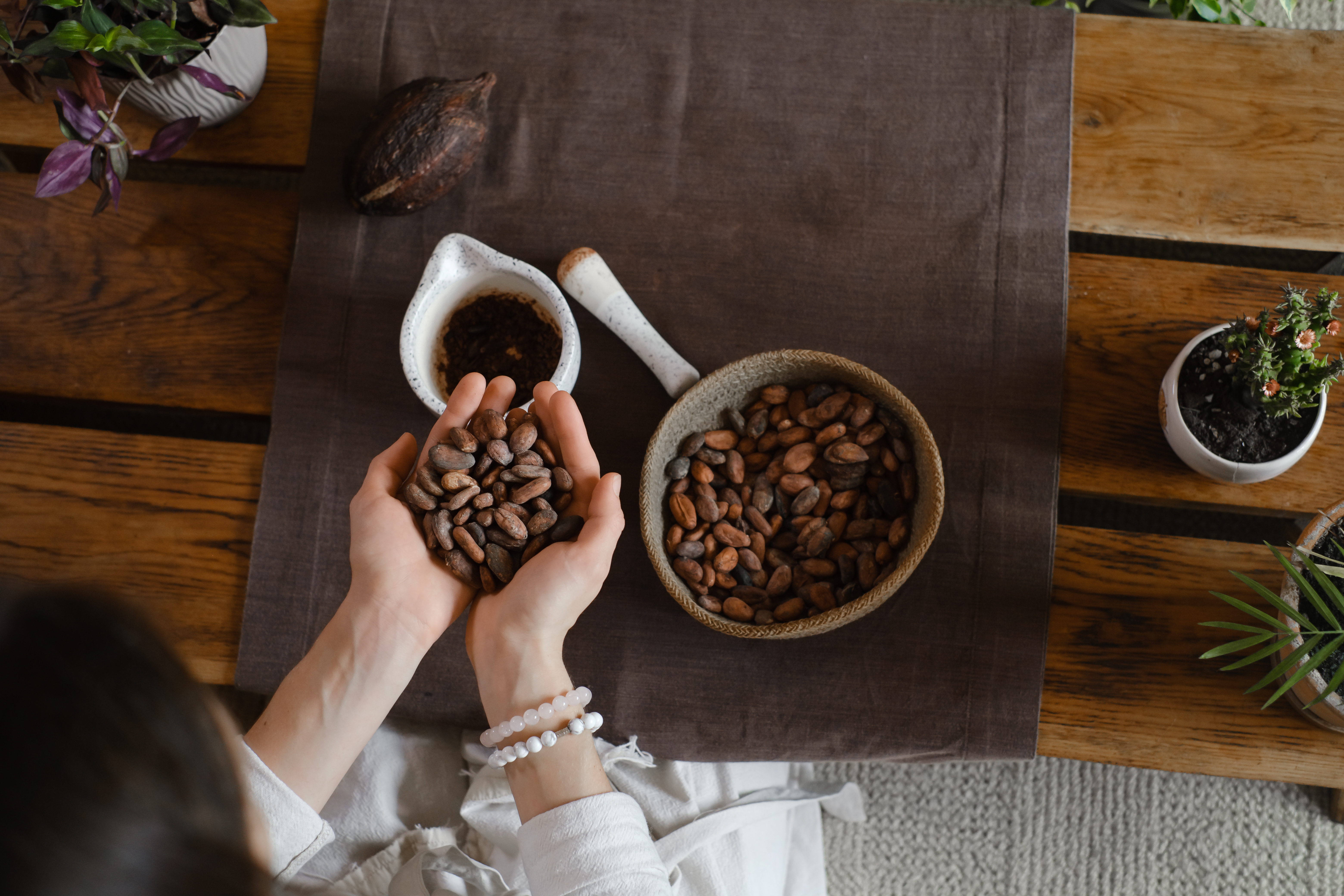
Ceremonial cacao is pure cacao mass: whole cacao beans ground into a paste, with none of their fat pressed out. It is melted in hot water and sipped slowly, most often as part of a quiet ritual or a ceremony.
The name does not refer to a separate variety of the plant. It describes how the cacao is prepared and what the drink is for. Below we explain what ceremonial cacao is made of, where the tradition of drinking it comes from and how to prepare it at home.
What is ceremonial cacao made of?
The cacao tree (Theobroma cacao) is a tropical tree that Carl Linnaeus named in 1753 with a word meaning "food of the gods". Its pods grow directly on the trunk and thick branches. Each pod holds several dozen seeds wrapped in white, sweetish pulp.
The seeds ferment for several days in wooden boxes or under banana leaves. Then they dry in the sun, are gently roasted or not roasted at all, and finally are shelled and ground into a thick paste. The paste sets into blocks, discs or flakes. Nothing is taken out of it and nothing is added.
Everything that was in the bean stays in the cacao mass:
- cacao butter, which makes up roughly half of the mass,
- the fibre and protein of the bean,
- the full aroma, which depends on the variety, the region and the way the beans were fermented.
How is ceremonial cacao different from cocoa powder?
Cocoa powder is made from the same mass, but only after most of the fat has been pressed out. What remains after pressing is milled into a loose powder. It is often also alkalised to give it a darker colour and a milder taste.
Ceremonial cacao is thick, rich and velvety. Powder makes a thinner drink with a flatter taste. A detailed comparison with cocoa powder, drinking chocolate and dark chocolate is in our article ceremonial cacao vs regular cocoa.
Where does the tradition of drinking cacao come from?
The oldest traces of cacao use are about 5,300 years old. They were found in the upper Amazon, in today's Ecuador, in vessels of the Mayo-Chinchipe culture. From there the plant travelled to Mesoamerica.
The Olmecs, and after them the Maya, prepared a thick drink of cacao and water. They added maize, chilli or flowers, and made the foam by pouring the drink from a height between two vessels. Cacao accompanied weddings, births and rites in honour of the gods.
Among the Aztecs, cacao beans were even used as money. The drink was reserved for rulers, priests and warriors. The modern form of the cacao ceremony developed at the beginning of the 21st century, among other places on the shores of Lake Atitlán in Guatemala. Today it is a gathering in a circle, an intention, silence and slow drinking. How to hold such a ceremony is described in our article a cacao ceremony at home.
How to prepare ceremonial cacao at home
It takes a few minutes. You need a pot, a whisk or milk frother and good water.
- Chop or grate the block into small pieces. The smaller they are, the faster they melt.
- Heat the water, but do not let it boil. Very hot but not boiling water does not scorch the fat or carry away the aroma.
- Put the cacao into the pot and pour in the water gradually, stirring all the time, until the mass has completely melted.
- Froth the drink with a whisk, a frother or a blender. This is the modern version of the Maya way of pouring from a height.
- Add spices if you like: cinnamon, cardamom, vanilla or a pinch of chilli. Leave any sweetening until the very end.
Everyone chooses the proportions to taste. Less water gives a drink as thick as pudding, more water gives a lighter one. Traditionally cacao is made with water. Made with milk or a plant-based drink it is milder and creamier.
What does ceremonial cacao taste like?
The first impression is a deep bitterness and a rich, enveloping texture. Then come notes that depend on the origin of the beans: fruit, nuts, flowers, caramel or earth.
- Criollo gives a delicate, complex taste with low bitterness.
- Forastero gives a strong, classic cacao taste.
- Trinitario combines the features of both.
- Nacional from Ecuador is famous for its floral aroma.
The differences between countries are described in our article where ceremonial cacao comes from.
How to recognise good ceremonial cacao
- The only ingredient is cacao mass, with no sugar, milk powder or lecithin.
- The producer names the country of origin, ideally the region as well.
- The cacao comes as a block, discs or flakes, not as a loose powder.
- When opened it smells intense and clean, with no musty notes.
- It breaks with a clear snap and has an even colour in cross-section.
A white or grey bloom on the surface does not mean the cacao has gone off. It is fat bloom, which appears after changes in temperature. It disappears without a trace once the cacao is melted in hot water.
How to store ceremonial cacao
Keep it in a dry, dark and cool place, in a tightly closed package. Cacao mass easily absorbs smells, so do not keep it next to spices, coffee or cosmetics. There is no need for the fridge, and moisture from it can harm the cacao.
Ceremonial cacao at Las Szamana
In our ceremonial cacao category you will find cacao mass from several countries. Each cacao comes from a single country, so it is easy to compare flavours. It is best to start with Dominicalm cacao from the Dominican Republic, because its taste is gentle and well balanced. If you like more pronounced, fruity notes, reach for ChocoLumbia cacao from Colombia.
Cacao in history and in research
For decades it was believed that cacao was domesticated by the Olmecs and the Maya in Mesoamerica. In 2018 an international team of archaeologists led by Sonia Zarrillo described in Nature Ecology & Evolution finds from the Santa Ana-La Florida site in south-eastern Ecuador. On vessels of the Mayo Chinchipe culture they discovered cacao starch grains, traces of theobromine and ancient cacao DNA from about 5,300 years ago. It is the oldest known evidence of cacao use in the world, about 1,500 years older than the traces from Mesoamerica. The cradle of cacao turned out to be the upper Amazon basin.
For ancient peoples cacao was more than a drink. The Aztecs paid with cacao beans at markets and offered them as tribute, and cacao drinks accompanied feasts, weddings and rites. When Carl Linnaeus gave the cacao tree its scientific name in 1753, he chose the word Theobroma, "food of the gods".
Cacao is still an everyday drink of the Kuna (Guna) people, who live on the islands off the Caribbean coast of Panama. The islanders drink several cups of home-made, minimally processed cacao a day. A team led by Norman Hollenberg of Harvard Medical School noticed that the blood pressure of the island Kuna does not rise with age, while among those who moved to the city and drink little cacao it rises as it does in other Panamanians (McCullough et al., 2006). The researchers link this difference with flavanols, compounds found in minimally processed cacao, although many other factors also shape the islanders' way of life.
Cocoa flavanols were also tested in the large COSMOS clinical trial (Sesso et al., American Journal of Clinical Nutrition, 2022). More than 21,000 older adults took a cocoa flavanol extract or a placebo for an average of 3.6 years. The extract did not significantly reduce the total number of cardiovascular events, but the group taking it had 27% fewer deaths from cardiovascular causes. The trial tested a concentrated extract (500 mg of flavanols a day), not a cacao drink, so the results cannot be transferred directly to a cup of cacao. They do show why scientists look so closely at the plant the Maya called a gift of the gods.
Cacao naturally contains theobromine and a small amount of caffeine. If you are pregnant, breastfeeding or take medication regularly, consult your doctor. Keep cacao out of reach of dogs and cats.
Frequently asked questions
Is ceremonial cacao the same as raw cacao?
Not always. "Raw" means beans that were not roasted or were roasted at a low temperature. Ceremonial cacao is sometimes gently roasted. What makes it ceremonial is the pure, full-fat mass of the whole bean.
Can ceremonial cacao be made with milk?
Yes. Tradition is based on water, but a drink made with milk or a plant-based drink is milder. Many people start with a mix of water and milk.
Why is ceremonial cacao more expensive than regular cocoa?
Because it is the whole mass of the bean, not what is left after the butter has been pressed out. On top of that come selected varieties and hand fermentation and drying. In 2024 world cacao prices reached a record level, which every seller feels.
Can ceremonial cacao be used for baking?
Yes, you can melt it and add it to a cake or dessert. Its taste shows most fully, though, in a hot, frothy drink.
Sources
- Zarrillo, S. et al. (2018). The use and domestication of Theobroma cacao during the mid-Holocene in the upper Amazon. Nature Ecology & Evolution, 2, 1879-1888. doi:10.1038/s41559-018-0697-x
- McCullough, M. L. et al. (2006). Hypertension, the Kuna, and the epidemiology of flavanols. Journal of Cardiovascular Pharmacology, 47 (Suppl 2). PubMed
- Sesso, H. D. et al. (2022). Effect of cocoa flavanol supplementation for the prevention of cardiovascular disease events: the COSMOS randomized clinical trial. American Journal of Clinical Nutrition, 115(6), 1490-1500. PubMed