







A tensor ring is a closed loop made of twisted and then coiled wire, most often copper. It has a precisely defined length, calculated according to an ancient measure called the cubit. It is worth separating two layers from the start: the material and construction, which can be measured and seen, and the energetic meaning, which comes from the practice of its creator and his followers. Below we talk about both, so that everyone can consciously choose what the ring is to be for them.
What are tensor rings and how do they work? The short answer
According to their creators, a tensor ring orders and amplifies a subtle field around itself. They describe it as a "tensor field" that supports calm, stillness and a sense of balance. This is why rings are placed under a glass of water, beside plants, in a meditation space, or worn as jewellery.
The word "tensor" itself comes from mathematics and physics, where it means an object describing quantities that depend on direction, for example stresses in a material or the curvature of spacetime. The creator of the rings borrowed the word to name what he himself described as a field around a closed circuit. It is the language of the dowsing tradition and sacred geometry. For many people the ring is above all a ritual object and a tool of mindfulness.
Where they came from: Slim Spurling and the 1990s
Tensor rings are associated with the name of Slim Spurling (1938 to 2007), a self-taught American researcher from Colorado. At the end of the 20th century he experimented with wire shapes and developed a set of tools he called "Light-Life" technology. He was looking for simple forms which, in his view, harmonise the surroundings, water and plants. It was a current close to dowsing and the tradition of sacred geometry.
The most characteristic element of his idea is the length of the wire. Spurling drew on ancient cubit measures, including the royal cubit known from Egypt, and divided or multiplied these lengths. This is why ring descriptions use terms such as "full cubit" or "half cubit". In this tradition it is the proportion, not the diameter alone, that decides the character of a ring. We write more about the measure itself in our article the royal cubit: an Egyptian measure.
How a tensor ring is made
The construction can be seen with the naked eye. A typical ring is made in a few steps:
- Wire: usually copper, sometimes silver or copper combined with brass. Copper was chosen for its good conductivity, ease of working and long presence in folk traditions.
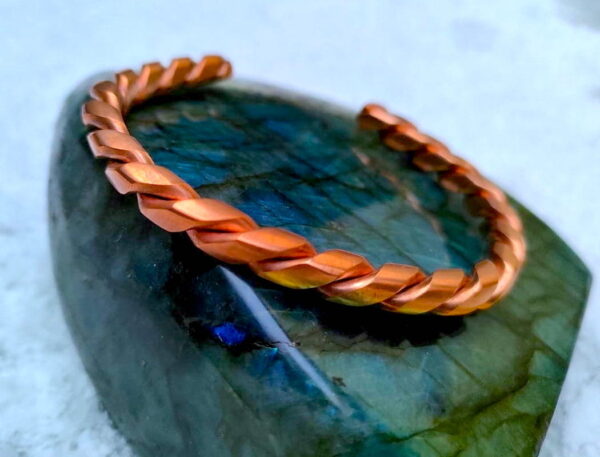
- Twist: the wire is folded in half, or two lengths are joined and twisted together, forming a spiral cord.
- Length: it is cut according to the chosen cubit measure before the cord is coiled into a circle.
- Closure: the ends are joined to form a loop. The method of joining differs from maker to maker.
A tensor bracelet is made in the same way. It is a ring whose length is chosen so that it can be worn on the wrist. In the broader sense we speak of tensor jewellery, which includes bracelets, necklaces and small finger rings.
Tensor rings in practice and in tradition
People who work with tensor rings describe above all their own experiences: greater calm during meditation, a sense of a space being closed and held, and the pleasure of a daily ritual. Slim Spurling saw the ring as a tool for harmonising the surroundings. He placed rings under vessels of water, in the garden and beside plants, and held them in his hands during meditation. Many people continue these practices today.
Copper has had its place in the world's traditions for millennia. In India water is kept in copper vessels, in ancient Egypt copper was linked with the goddess Hathor, patroness of the mines of Sinai, and in Europe copper ornaments were worn as amulets. The tensor ring joins this old respect for copper with the precise geometry of the cubit. For many people it is a carrier of intention and a daily reminder of mindfulness.
A daily ritual: morning and evening
If you want to bring the ring into everyday life, it is best to link it with a fixed time of day. It is regularity that builds the habit of mindfulness.
In the morning
- Stand a glass of water on the ring before you brew your tea or coffee. Drink it slowly, after a few minutes.
- Put on your tensor bracelet while setting one intention for the day. It can be a single sentence, for example "today I listen before I answer".
In the evening
- Take off your jewellery and put it in a fixed place. It is a signal that the day is closing.
- Sit for five to ten minutes with the ring in your hands, or lay it beside you while you breathe calmly. You can combine this with an infusion of chamomile, lemon balm or linden, herbs that have been present in Polish homes for generations as evening infusions.
How to read a ring or bracelet description before you buy
Pay attention to a few specifics:
- Material: solid copper, silver, or copper with brass. Solid copper darkens over time and may leave a greenish mark on the skin, which washes off.
- Nickel: people with sensitivities should look for jewellery compliant with the EU restriction on nickel release (the REACH regulation, testing according to standard EN 1811).
- Length and size: a good seller gives the cubit measure or the circumference. For a bracelet, measure your wrist and add about a centimetre of ease.
- Finish: lacquer slows the darkening of copper but wears off with time. Unlacquered copper can be cleaned with vinegar and salt or lemon juice.
At Las Szamana we have gathered our hand-twisted models in one collection, tensor rings and bracelets, where we give the material and size of each model. For everyday wear, see the tensor bracelets section. You will find larger rings for under a glass, a plant pot or a home meditation corner in the tensor rings section. It is best to start with one ring and one fixed place at home, for example beside the water you drink in the morning.
Copper in history and in science
Copper has accompanied people for thousands of years and has always been held in esteem. The Copper Development Association recalls that the Edwin Smith Papyrus, an Egyptian medical text written down around 1600 BCE on the basis of much older records, already mentions the use of copper to clean wounds and drinking water. In India the Ayurvedic tradition has for centuries recommended keeping water in copper vessels. This custom, called tamra jal, is alive to this day.
Modern science has proved the ancients right. On 29 February 2008 the US Environmental Protection Agency (EPA) registered copper alloys as an antimicrobial material. Tests carried out under EPA protocols showed that regularly cleaned surfaces of copper, brass and bronze eliminate more than 99.9% of bacteria within two hours. Copper was the first solid material to receive such an official claim, which is why it is increasingly found in hospitals, on door handles and on railings. The registration concerns surfaces, not jewellery, but it shows well why this metal has been regarded for centuries as noble and purifying.
More about tensors at Las Szamana
Tensors are history, measure and craft. Take a look at our other articles:
- The tensor bracelet, how to recognise, wear and clean it
- The royal cubit, the Egyptian measure behind the length of tensors
Tensor rings: Ra-Mu Cubit, Viking Cubit, Galactic Cubit, double Lost Cubit, double Royal Cubit.
Tensor bracelets: Ra-Mu Cubit, Viking Cubit, Galactic Cubit, Lost Cubit 177 MHz, Empowerment Cubit 188 MHz, New Earth Cubit 432 MHz, Phi Cubit 256 MHz.
Copper wire cubits: Royal Cubit 17.6 cm, Royal Cubit 1/2, 8.7 cm, Lost Cubit 1/2, 9.9 cm, Initiation Cubit 24.5 cm, Stu Harmony Cubit 1/2, 17.6 cm, full cubit harmonizer.
You will find the whole collection in the tensor rings and bracelets category, and separately in the tensor rings, tensor bracelets and tensor necklaces sections.
Frequently asked questions
Can a tensor ring be worn every day?
Yes. Copper is pleasant to wear and develops a fine patina over time. For some people it leaves a greenish mark on the skin, a natural reaction of the metal with sweat, which washes off.
Does the ring need to be "cleansed"?
In the tradition some people lay it overnight on a windowsill or beside a plant. From a practical point of view, ordinary cleaning of the copper when it darkens is enough.
How does a tensor ring differ from an ordinary copper band?
In the twist of the wire and the length chosen according to the cubit. Physically both objects are copper. The difference lies in the construction and the intention with which they are used.
Sources
- Regulation (EC) No 1907/2006 (REACH), Annex XVII, entry 27: restriction on the release of nickel from articles in contact with the skin.
- Standard EN 1811:2011+A1:2015, reference test method for the release of nickel from articles in prolonged contact with the skin.
- Copper Development Association. Medical Uses of Copper in Antiquity. copper.org
- U.S. Environmental Protection Agency (2008). EPA registers copper-containing alloy products. epa.gov (archive)