













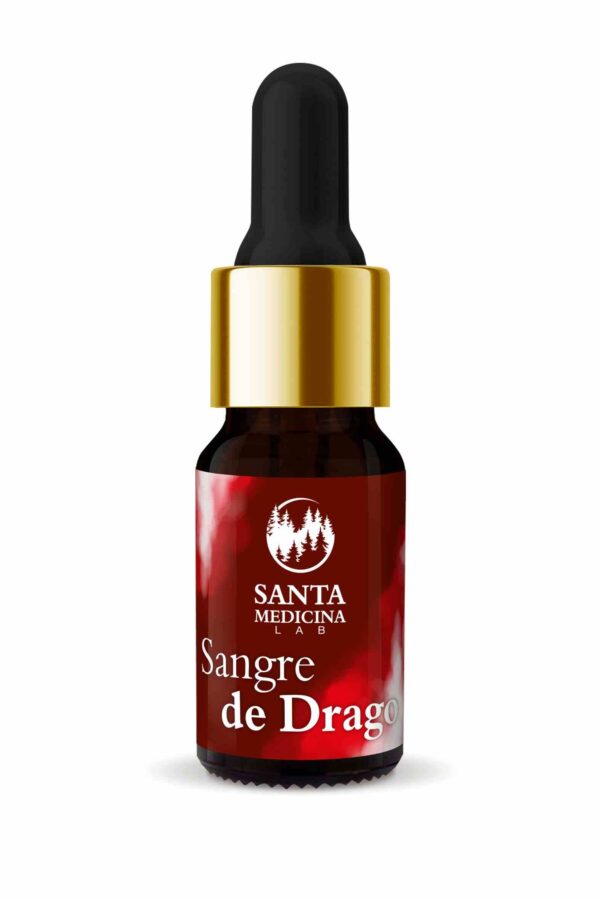
Sangre de Drago (Spanish for "dragon's blood"), more often called sangre de grado in Peru, is a dark red latex that flows from the cut bark of the Amazonian tree Croton lechleri of the spurge family (Euphorbiaceae). The most important distinction is simple: Amazonian sangre is a liquid taken from a living tree. The hard, brittle "dragon's blood" sold as incense or pigment comes from completely different plants, from Dracaena trees and Daemonorops palms. All they share is the colour and the name.
People who search for "sangre" usually want to know several things at once: what it actually is, where it comes from, whether it is the same as incense and how to tell real sap from a fake. We answer these questions one by one.
How does sangre de drago differ from the resin called dragon's blood?
The name "dragon's blood" has travelled across continents since antiquity and has attached itself to at least three unrelated groups of plants. A 2008 review by Gupta and co-authors sorts them out as follows:
- Croton lechleri and related Croton species from South America: a liquid, red latex from the bark. This is true sangre de drago.
- Dracaena cinnabari and Dracaena draco from Socotra and the Canary Islands: a solid resin known to the Greeks and Romans, used as a dye and varnish.
- Daemonorops draco from Southeast Asia: a resin coating the fruit of a rattan palm, today the most common ingredient of incense sticks called dragon's blood.
So if you see lumps or sticks in a shop, you are holding resin for burning. If you see a thick liquid in a bottle labelled Croton, it is the Amazonian latex. This text concerns only the latter.
Which tree does sangre come from and where does it grow?
Croton lechleri grows in the western Amazon basin, on the border between lowland forest and the Andean foothills: in Peru, Ecuador, Colombia and Bolivia. It is a pioneer tree. It likes light, riverbanks, landslides and clearings, the places where the forest is just regenerating. It grows quickly and usually reaches more than ten metres, with heart-shaped leaves that turn orange before they fall.
A curiosity that is rarely written about: the latex is not the same everywhere. In 2002 Milanowski and colleagues described three chemotypes of Croton lechleri that differ in alkaloid content depending on region. Sap from one river valley may therefore have a slightly different profile from sap gathered a few hundred kilometres away. That is why the country and region of origin are not decoration but real information.
What does harvesting the red latex in the forest look like?
Harvesters cut the bark of the trunk, and drops resembling blood slowly ooze from the wounds. It is a sight that best explains the name: no legends of dragons are needed, it is enough to see a tree that "bleeds".
For a long time, however, demand was met by plunder. Trees were felled to get more raw material at once. Today more and more suppliers rely on planted trees and on tapping that allows the plant to regenerate. Because Croton lechleri grows quickly and copes well with cultivation on degraded land, it is mentioned as a good species for forest restoration. In our forest way of thinking, respect for a plant begins right here, at the trunk, not only at the bottle.
Why does sangre turn from red to cream on the skin?
This question comes up very often, because the effect is truly surprising. The dark red liquid, rubbed on the skin, lightens within moments, turns pink and then creamy beige, and dries into a thin, flexible layer. In the Amazon it is vividly called a "second skin".
This is mainly due to proanthocyanidins, polyphenolic polymers that make up a large part of the latex's dry mass. On contact with air, moisture and the proteins of the skin's surface, they change structure and colour, and at the same time bind into a thin film. It is a chemical phenomenon rather than magic, though it is no wonder that it has inspired admiration for generations.
How do the peoples of the Amazon traditionally relate to sangre de grado?
Among the communities of the western Amazon, both Indigenous and mestizo, the sap of this tree has long been part of household plant knowledge. A 2003 review by Kenneth Jones describes it as one of the most widespread folk materials of the region, present from village huts to the markets of Lima and Quito. Traditionally it was rubbed on the skin after small scrapes and insect bites, which are an everyday matter in the forest.
It is worth noting that sangre is not a ceremonial plant in the way some other Amazonian plants are. It is rather a companion of daily life: something carried in a bag while working in the chacra, the forest plot, and reached for without ceremony. Yet in this simple, practical relationship with the tree there is a great deal of humility. The tree gives its sap, but only when it is wounded, and in traditional thinking this exchange is something that calls for moderation.
What does phytochemistry say about the latex's composition?
Sangre is one of the better studied materials of the Amazon. The most often described constituents are:
- Proanthocyanidins: the main fraction of the latex, responsible for its astringent character and its change of colour.
- Taspine: an alkaloid that Vaisberg and colleagues isolated and studied in the laboratory in 1989. Its content differs between chemotypes.
- Dimethylcedrusin: a lignan described by Pieters and colleagues in 1993.
- Smaller amounts of flavonoids, phenolic acids and diterpenes typical of the genus Croton, as summarised in a 2007 review by Salatino and co-authors.
These observations come from laboratory studies and beautifully show why the peoples of the Amazon have valued the sap of this tree for generations. Vaisberg called taspine outright the "cicatrizant principle" of sangre de grado, the compound that explains the old practice of rubbing the sap on scrapes. Once again science has arrived where folk knowledge had long been.
How to recognise real Croton sap and how to store it
A few simple tips help distinguish the Amazonian latex from products that merely borrow its name:
- Latin name. It should point to Croton lechleri or another Croton species. Dracaena or Daemonorops mean resin.
- Appearance. Pure sap is thick and, in the glass, almost brownish red. A watery, pale pink liquid suggests heavy dilution.
- The drop test. Real latex rubbed between the fingers lightens to a cream colour. Dyes do not.
- Origin. Peru and Ecuador are the most common sources, and a mention of harvesting without felling trees shows the supplier's care.
The latex does best in dark glass, tightly closed, away from sunlight and heat. Over time it may thicken and dry at the neck, so it is worth wiping the thread before closing. Remember too that the sap permanently stains fabric and wood. In our shop you will find Sangre de Drago with a description of its origin.
If you are pregnant or breastfeeding, or take medication regularly, consult a doctor before use.
Frequently asked questions about sangre
Are sangre de drago and sangre de grado the same?
Yes. They are regional variants of the name of the same latex. "Grado" is more common in Peru, "drago" in Ecuador and in international trade.
Can sangre be burned like incense?
No, it is a liquid. Solid Daemonorops or Dracaena resin is used for burning, a different plant and a different product.
Is the sap eco-friendly if the tree has to be cut?
It depends on the supplier. Tapping cultivated trees lets them regenerate, while felling wild trees is a plundering practice. It is worth asking the seller about the source.
Why does sangre from different sources look slightly different?
Region, the tree's chemotype, harvest season and any dilution all play a part. Small differences in shade and thickness are natural.
Sources
- Jones K. Review of sangre de drago (Croton lechleri): a South American tree sap. Traditional uses to clinical research. Journal of Alternative and Complementary Medicine, 2003; 9(6): 877-896.
- Gupta D, Bleakley B, Gupta RK. Dragon's blood: botany, chemistry and therapeutic uses. Journal of Ethnopharmacology, 2008; 115(3): 361-380.
- Vaisberg AJ et al. Taspine is the cicatrizant principle in Sangre de Grado extracted from Croton lechleri. Planta Medica, 1989; 55(2): 140-143.
- Pieters L et al. Isolation of a dihydrobenzofuran lignan from South American dragon's blood (Croton spp.) as an inhibitor of cell proliferation. Journal of Natural Products, 1993; 56(6): 899-906.
- Milanowski DJ, Winter RE, Elvin-Lewis MP, Lewis WH. Geographic distribution of three alkaloid chemotypes of Croton lechleri. Journal of Natural Products, 2002; 65(6): 814-819.
- Salatino A, Salatino MLF, Negri G. Traditional uses, chemistry and pharmacology of Croton species (Euphorbiaceae). Journal of the Brazilian Chemical Society, 2007; 18(1): 11-33.