










A sadhu board is a wooden board with several hundred blunt, evenly driven nails, on which you stand barefoot, usually for a short moment of focus. It is worth distinguishing it straight away from two things it is often confused with. It is not the bed of nails known from fakir shows, which you lie on, nor a soft mat with plastic spikes for massaging the back. A sadhu board is a hard object of metal and wood for standing on, and its intensity comes from the simple physics of pressure and from the way the body responds to it.
Where does the name sadhu board come from?
The word sadhu comes from Sanskrit and originally meant "good", "righteous", "one who reaches the goal". In India it is used for wandering ascetics who have left household life and devoted themselves to spiritual practice. Some of them were known for rigorous bodily exercises, and the image of a monk resting on nails entered the European imagination in the 19th and early 20th centuries, mainly through travellers and stage performances.
A common confusion of terms appears here. European posters spoke of "fakirs", although the word faqir has Arabic roots and originally referred to poor Sufi monks, not to Indian ascetics. The standing board popular today, on the other hand, is a modern object. It has spread in recent years, especially in Central and Eastern Europe, as a home tool for mindfulness practice. The name is thus a tribute to the old tradition of ascetics who sought peace of mind through work with the body.
For us, raised in the Polish landscape, a closer equivalent is something quite familiar: walking barefoot on the morning dew, on pine needles in a pine forest, on pebbles by a stream. Barefoot paths in parks and sensory gardens are based on a similar experience, a distinct, unusual feeling of the ground.
Why does standing on nails not hurt the feet?
This is the question people type into search engines most often, and it has a very matter-of-fact answer. Whether something pierces the skin is decided by pressure, that is force divided by the area on which it acts.
A single sharp nail concentrates the whole weight of the body on a tiny point, which is why it is dangerous. On a sadhu board two things happen at once:
- the weight is spread over many points, because under both feet there are usually from several dozen to over a hundred nails, depending on their spacing,
- the tips are blunted and rounded, so each of them presses on a slightly larger area than a point would.
An example: a person weighing 70 kg standing on a hundred nails loads each of them with roughly seven hundred grams. This is clearly felt, but with a blunt tip it is too little to break healthy skin. This is why it is so important that all the nails are the same height. A single protruding point takes a disproportionately large share of the pressure and becomes the most bothersome.
What do people feel when they stand on a sadhu board for the first time?
The accounts are surprisingly similar. The first seconds bring a sharp, prickling sensation, often stronger than expected. The body tenses reflexively and the breath becomes short. After a moment, when attention moves to a slow exhalation, many people describe a wave of warmth in the feet and a distinct "landing" in the body. Emotions also come: laughter, tears, irritation.
For this reason the sadhu board is treated rather as an exercise of attention. It has something in common with cold water or a barefoot walk in the forest: for a moment it stops the rush of thoughts, because the stimulus is too distinct to ignore. Many people speak of a sense of presence and contact with the body. In the tradition of reflexology the foot is a map of the whole body, and in the traditions of Ayurveda and Chinese medicine important energy channels run through the feet. For many practitioners this is a good point of reference that gives standing on the board an additional meaning.
Red dots may remain on the feet. They usually disappear within a quarter of an hour or so and are a trace of pressure, not of injury.
How does a sadhu board differ from a spiked mat?
The difference is greater than shop photos suggest.
- Material: the board has metal nails, most often copper, brass or steel, set in wood. A mat has plastic spikes on foam.
- Base: wood does not bend, so the pressure is constant. Foam partly cushions it.
- Purpose: the board is treated as an object for standing on. A mat is usually spread out to lie on.
- Durability: a well-made board of hardwood or plywood lasts for years, while plastic spikes wear down and bend over time.
Both have their place, but they are not substitutes. Those looking for a strong, focusing experience and an object that will stay in the home for years more often reach for the board.
When is it better to put the board aside for later?
It is better to wait before stepping on the board if you:
- have wounds, abrasions, cracked skin or inflammation on the feet,
- have reduced sensation in the feet or circulatory problems,
- are pregnant,
- are recovering from injuries to the feet, ankles or knees,
- have balance problems.
It is always good to step onto the board slowly, leaning on a wall or a chair, and to step off at once if dizziness or pain other than the usual prickling appears. Children and animals should not have free access to it.
How to care for a sadhu board so that it lasts for years
The board combines two materials that age differently, so care is simple but has its own logic.
Nails
Copper darkens over time and develops a patina. This is natural oxidation, similar to that seen on old roofs and bells. Those who like a bright shine can restore it with a soft cloth, but many owners deliberately leave the patina as a trace of years of practice. The nails are best cleaned with a dry, soft brush or a slightly damp cloth, and then dried thoroughly.
Wood
The board should not be soaked or washed under running water. Moisture penetrating the holes around the nails can loosen their seating over time. Oiled wood is worth wiping with a thin layer of wood oil from time to time. Store it flat, nails up, away from radiators and damp bathrooms, preferably under a cover or in a box.
Where to put a sadhu board at home?
A board hidden away in a cupboard usually gets forgotten. One that has its own place becomes part of the home landscape. It most often ends up in a quiet corner of the bedroom, beside a yoga mat or near a window with a view of the trees.
Many people build a small corner of stillness around it: a piece of wood, a plant, an object that recalls the forest. If you are thinking of such a place, forest palo santo, natural incense and forest essential oils go well with it. These are extras, though. The sadhu board with nails itself needs only a level floor and a little peace. It is best placed where you pass every day, so that it invites you to practise by itself.
If you have wounds or reduced sensation in your feet, are pregnant, or have circulatory problems, consult a doctor before starting the practice.
Frequently asked questions about the sadhu board
Is a sadhu board the same as a fakir's bed?
No. A bed of nails is for lying on and is associated with stage shows. A sadhu board is smaller, is for standing on and was created as a modern household object.
Do the nails have to be copper?
Not necessarily. Copper is the most traditional and ages beautifully, but brass and stainless steel are also found. More important than the material are blunted tips and an even height.
Can you stand on the board in socks?
Some people start in thin socks to soften the first impression. A sock spreads the pressure a little, but it does not change the character of the experience.
Why do red dots remain on the feet?
They are traces of momentary pressure on the skin. In most people they disappear quickly. If they last a long time or bleeding appears, it is worth stopping the practice and consulting a specialist.
Forest SadhuPress™ boards at Las Szamana
Also read our article how to stand on a sadhu board: feet, breath and the first step.
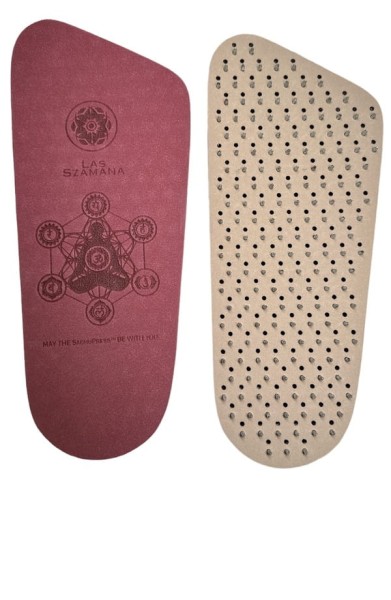
Our boards: Forest Shaman (orange and brown), Forest Shaman (grey and navy), Chakra Metatron (beige and burgundy), Chakra Metatron (grey and navy). You will find them all in the forest SadhuPress™ boards category.
Sources
- Monier-Williams M. A Sanskrit-English Dictionary. Oxford: Clarendon Press, 1899 (entry sādhu).
- Encyclopaedia Britannica, entries "sadhu" and "fakir" (origin and meaning of the terms).
- Forest Products Laboratory, USDA. Wood Handbook: Wood as an Engineering Material, FPL-GTR-190, 2010 (properties of wood, moisture and fastener retention).
- Halliday D., Resnick R., Walker J. Fundamentals of Physics, Wiley (chapter on pressure and the distribution of forces).
- Kunz B., Kunz K. Complete Reflexology for Life. Dorling Kindersley, 2007 (maps of the foot zones in the reflexology tradition).