







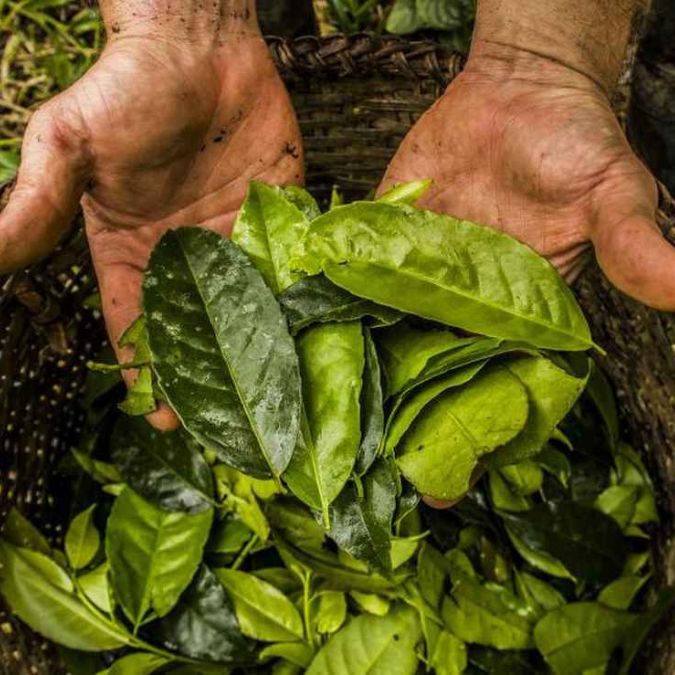
Guayusa (Ilex guayusa Loes.) is an evergreen tree of the holly family (Aquifoliaceae), growing in the western Amazon, above all in Ecuador. Its dried leaves are used to make an infusion containing natural caffeine. The most important distinction: guayusa is a close relative of yerba mate, but it is a different plant, from a different region and with a different taste. Yerba mate grows in the subtropics in the south of the continent, guayusa in the humid forest at the foot of the Andes. Botanically they are cousins, not two names for the same dried leaf.
What is guayusa and where exactly does it grow?
Guayusa grows to several metres, and in favourable conditions to more than ten. It has leathery, elongated leaves with slightly toothed edges, dark green and glossy on top. Its natural range covers the lowland and foothill forests of Ecuador, as well as the border areas of Peru and Colombia. The main centre of cultivation and tradition, however, remains Ecuador's Napo province.
A curiosity that botanists often stress is that guayusa very rarely flowers in cultivation. For centuries it has been propagated mainly from cuttings passed between families and villages. The trees usually grow in chakras, home forest gardens where edible, useful and wild plants live side by side. This makes guayusa more a plant of the home garden than of a monoculture plantation.
What does guayusa infusion taste like?
This is the question most people ask when they first hear the name. Guayusa infusion has a mild, rounded taste: grassy, with a delicate sweetness that some compare to honey and others to dried fruit. It lacks the sharp bitterness familiar from strongly brewed black tea or yerba mate. Reviews of its composition point to a relatively low tannin content, which explains why the infusion is not very astringent even when the leaves stay in the water longer.
The colour of the infusion depends on how the leaves were dried. It is usually golden or amber. Many people drink guayusa without anything added, others combine it with a slice of lemon or a little honey, but on its own it is pleasant enough that it rarely needs improving.
How does guayusa differ from yerba mate and ordinary tea?
All three drinks contain caffeine, but they differ in origin, taste and drinking culture.
- Yerba mate (Ilex paraguariensis) belongs to the same botanical genus as guayusa. It grows in Argentina, Paraguay and southern Brazil. It is often smoke-dried, which gives it a distinct, smoky-herbal, bitterish character. It is drunk from a gourd through a bombilla, with the same portion topped up many times.
- Tea (Camellia sinensis) belongs to a completely different plant family. It has more tannins, and its taste depends strongly on the degree of leaf oxidation, from green to black.
- Guayusa has the mildest profile of the three. Besides caffeine, phytochemical reviews list small amounts of theobromine, known from cacao, and polyphenols, including chlorogenic acids.
It is worth remembering that a mild taste does not mean no caffeine. Guayusa is a stimulating drink in the same sense as tea, and the amount of caffeine in a cup varies with the batch of leaves and the way it is brewed.
How do the Kichwa drink guayusa before dawn?
For the Kichwa of the Napo region, guayusa is a drink of the community. According to ethnobotanical descriptions, families rise in the dark, long before sunrise. The women light the fire and boil the leaves in a large pot, and the household gathers around the hearth. This morning custom is called wayusa upina, the drinking of guayusa.
During these hours dreams are told and their meaning is sought together. The elders pass on stories, songs and knowledge of the forest to the young, and plans for the coming day are discussed: hunting, work in the chakra, a trip to the river. Guayusa is more a reason to be together than an end in itself. In some accounts it is called the plant that lets you keep watch while others sleep.
Other Amazonian peoples had their own customs. Among the Achuar and Shuar, ethnobotanists described the morning drinking of a very strong infusion, ending in deliberate regurgitation of the liquid, treated as a ritual cleansing before the day. These practices belong to particular cultures, have their own measure and meaning, and so we describe them with respect, as testimony to a tradition rather than a model to follow.
What does archaeology tell us about the history of guayusa?
One of the most famous finds comes from Bolivia. In a tomb in the Niño Korin valley, high in the Andes, a set of objects belonging to an ancient healer was discovered, and among them were guayusa leaves. Richard Evans Schultes, one of the fathers of modern ethnobotany, described this find and dated it to roughly the 5th century AD. Because guayusa does not grow at those altitudes, the leaves must have travelled hundreds of kilometres from the Amazonian lowlands.
This shows that Amazonian plants were valued goods on the ancient exchange routes between forest and mountains. Guayusa travelled alongside other ritual and useful plants, and its presence in a tomb shows how highly it was prized.
Why can't European holly replace guayusa?
Since guayusa is a holly, it is easy to ask whether a similar infusion could be made from a plant growing in Europe. The answer is no. Common holly (Ilex aquifolium), known from Christmas wreaths, has no tradition of being drunk as an everyday infusion, and its red berries are poisonous. Kinship within a genus does not mean similar properties.
In the Polish and European herbal tradition, people reached for mint leaves, linden flowers or St John's wort for their morning infusions, and caffeine came to us only with coffee and tea. Guayusa is therefore a guest from afar. It is worth getting to know it with curiosity, but without assuming that every plant of the same family hides similar gifts.
How to prepare and store guayusa leaves at home
In the European Union guayusa is authorised as a traditional food from a third country in the form of dried leaves for infusions, so preparing it is like brewing tea. The leaves are covered with hot water and left for a few minutes under a lid. The Kichwa boil them longer in a large pot, making an infusion for the whole family. Guayusa can also be covered with cold water and left overnight in the fridge, giving a refreshing summer drink.
Storage matters a lot for the taste. The dried leaves are best kept in an airtight, opaque container, away from light, moisture and strong smells such as spices or coffee, which the leaves easily absorb. Well-stored guayusa keeps its mild, honeyed aroma for many months.
Frequently asked questions about guayusa
Does guayusa contain caffeine?
Yes. Caffeine is the main stimulating compound in guayusa leaves. The amount in an infusion depends on the batch and the way it is prepared, so guayusa is best treated like any other caffeinated drink.
When is guayusa traditionally drunk?
Among the Kichwa, above all in the hours before dawn and in the morning. Because of its caffeine content, many people in Europe also choose it for the first half of the day, and reach for caffeine-free plants in the evening.
Is guayusa the same as yerba mate?
No. They are two different species of the same genus Ilex, coming from different regions of South America and differing in taste and drinking culture.
Is guayusa suitable for everyone?
Like any caffeinated drink, it is not meant for children.
If guayusa has awakened your curiosity about plants from distant forests, take a look at our guayusa category. It is best to start with green guayusa in dried leaves, because it comes closest to the infusion the Kichwa boil before dawn. We write about other plants with stories of the forest peoples in our article the sacred plants of the Amazon. Get to know each plant calmly, with curiosity and respect for the places it comes from.
If you are pregnant or breastfeeding, or take medication regularly, consult a doctor before use.
Sources
- Dueñas J.F., Jarrett C., Cummins I., Logan-Hines E. (2016). Amazonian guayusa (Ilex guayusa Loes.): a historical and ethnobotanical overview. Economic Botany, 70(1).
- Wise G., Negrin A. (2020). A critical review of the composition and history of safe use of guayusa: a stimulant and antioxidant novel food. Critical Reviews in Food Science and Nutrition, 60(14).
- Lewis W.H., Kennelly E.J., Bass G.N., Wedner H.J., Elvin-Lewis M.P., Fast W.D. (1991). Ritualistic use of the holly Ilex guayusa by Amazonian Jivaro Indians. Journal of Ethnopharmacology, 33(1-2).
- Schultes R.E. (1972). Ilex guayusa from 500 A.D. to the present. Etnologiska Studier, 32 (description of the Niño Korin find, Bolivia).
- Commission Implementing Regulation (EU) 2017/2470 establishing the Union list of novel foods, entry: dried leaves of Ilex guayusa as a traditional food from a third country.
- EFSA Panel on Dietetic Products, Nutrition and Allergies (2015). Scientific Opinion on the safety of caffeine. EFSA Journal, 13(5):4102.