






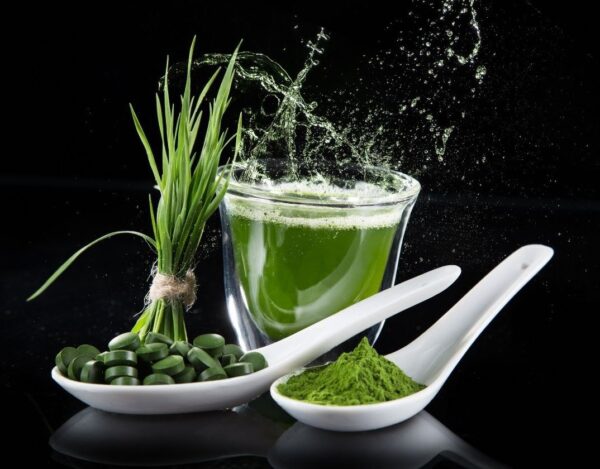
Chlorella is a single-celled freshwater green alga from the division Chlorophyta: a microscopic, spherical organism with a cell nucleus and a chloroplast, sold as a dark green powder or pressed tablets. The most important distinction is simple. Chlorella belongs to the green algae, distant relatives of land plants. Spirulina (Arthrospira platensis), with which it is most often confused, is a cyanobacterium, that is a bacterium that carries out photosynthesis. Both are green and both stand on the same shelf, but they are completely different beings.
What is chlorella and why do biologists call it a green alga?
The name comes from the Greek chloros, green, and the Latin diminutive -ella. The genus was described in 1890 by the Dutch microbiologist Martinus Beijerinck, who studied the tiny life of fresh waters. A single chlorella cell is only a few micrometres across, so thousands of them fit in a drop of water.
Green algae are the group from which land plants once arose. They have the same type of chlorophyll (a and b), store starch and build cell walls. This is why chlorella, although it has no leaves or roots, is more closely related to the nettle growing by the fence than to the spirulina it shares a jar with in the shop.
A curiosity for the inquisitive: the name Chlorella pyrenoidosa, still common in trade, is today more traditional than precise. Molecular studies have shown that many strains formerly described this way belong to other species, for example Chlorella sorokiniana or Auxenochlorella pyrenoidosa. Chlorella vulgaris is also found in trade alongside it.
Where does chlorella come from and how did it travel from the laboratory to the table?
Wild chlorellas live almost everywhere, Poland included: in ponds, drainage ditches, puddles and on damp bark. The green film on a forest pond can contain whole colonies of them. It is not, however, a plant gathered from the wild like St John's wort or wild thyme. Chlorella became food only in the 20th century, and its story is one of laboratories, not of herb women.
After the Second World War scientists were looking for a cheap source of protein for a growing population. In 1953 the Carnegie Institution of Washington published an extensive report edited by John Burlew on large-scale algae cultivation, and chlorella was its heroine. In Japan research was carried out by the Tokugawa Institute for Biological Research, and commercial production began there in the 1960s. Taiwan soon followed and remains one of the important cultivation centres to this day.
Today chlorella is grown in three ways:
- in open ponds, where the cells grow in sunlight, stirred by paddles;
- in closed photobioreactors, transparent tubes or panels that limit contact with the surroundings;
- in fermenters, where the alga grows in darkness on a sugar medium, which usually gives a lighter colour and a milder taste.
After harvesting, the cell mass is washed, processed and dried, most often by spray drying, until a fine green dust is formed.
How does chlorella differ from spirulina, apart from the name?
This question comes up most often, so let us gather the differences in one place:
- Structure: chlorella is a spherical cell with a nucleus and a thick wall, spirulina forms spiral filaments without a cell nucleus, with a delicate sheath.
- Colour: chlorella has a deep bottle green thanks to its large amount of chlorophyll. Spirulina also contains phycocyanin, a blue pigment, so its shade tends towards a sea blue-green.
- Smell: chlorella smells of grass, spinach and a little of green tea. Spirulina has a more marine note, reminiscent of seaweed.
- Living conditions: chlorella grows well in ordinary fresh water, spirulina likes warm, strongly alkaline waters, like the African soda lakes.
The simplest way to see this for yourself: stir a pinch of each powder into a separate glass of water and stand them side by side by the window.
What does a "broken cell wall" in chlorella mean?
The cell wall of chlorella is multi-layered and exceptionally tough, containing among other things cellulose and polymers that are hard to break down. In nature it is its armour. In food this means that the contents of the cell remain partly enclosed.
This is why producers subject the raw material to mechanical processing, for example grinding in ball mills, high pressure or ultrasound. The term "broken cell wall" refers to exactly this stage. Spirulina does not need it, because its sheath is thin and soft. It is one of the clearest examples of how the biology of an organism determines the technology.
What does chlorella taste like and what do people combine it with in the kitchen?
The taste of chlorella is distinctly vegetal: grassy, slightly bitter, with a delicate sweetness and a note reminiscent of nori seaweed. For some it is a pleasant memory of a meadow, for others a taste too intense to drink with water alone.
This is why in the kitchen chlorella usually disappears in the company of stronger flavours:
- in smoothies with banana, mango or pineapple, where the sweetness of the fruit balances the bitterness;
- in a green pesto with basil, parsley and sunflower seeds;
- in a sauce of tahini, lemon and garlic;
- in energy balls of dates and nuts, which it gives the colour of forest moss.
High temperature dulls its green and changes its aroma, which is why it is added at the end, to dishes that have already cooled. In many homes making such a smoothie becomes a small, mindful gesture: the same mug, a moment of silence, a look at a colour that recalls the forest after rain.
How to store chlorella so that it keeps its colour and smell
Chlorophyll and carotenoids are sensitive to light, heat and oxygen, and fine powder easily absorbs moisture. Green powders are therefore worth treating like dried herbs in a good pantry:
- an airtight, dark container or the original resealable packaging;
- a cool cupboard away from the cooker, kettle and dishwasher;
- a dry spoon, because even a drop of water forms lumps.
Well-stored chlorella has an even, dark green colour and a fresh, grassy scent.
Powder or tablets: which form of chlorella do people choose?
Powder gives freedom in the kitchen and lets you see and smell the raw material. Pressed tablets bypass the question of taste and are convenient when travelling, but they are no good for pesto. The choice therefore depends more on lifestyle than on the plant itself. It is worth looking at the species name, the country of origin of the raw material and the method of cultivation, because these three pieces of information say the most about the character of a product.
At Las Szamana you will find Chlorella Pyrenoidosa with broken cell walls in tablets and Bio Chlorella. If you want to compare two green worlds, set Spirulina Platensis beside it. It is best to start with the powder, to see and smell the raw material, and then move on to tablets for the daily rhythm. Set side by side, they teach more than the longest description.
Frequently asked questions about chlorella
Is chlorella a seaweed?
Not in the everyday sense. Seaweeds are large marine algae, such as kombu or nori. Chlorella is a microscopic freshwater green alga, visible only in mass, as a green tint in the water.
Does chlorella grow in Poland?
Yes, wild strains occur in Polish fresh waters and damp places. Food-grade raw material, however, comes from controlled cultivation, most often in Asia and increasingly also in Europe.
Is chlorella a novel food in Europe?
According to the European Union Novel Food Catalogue, several species of chlorella, including Chlorella pyrenoidosa and Chlorella vulgaris, were consumed to a significant degree before 1997, so they do not require authorisation as a novel food.
What should I bear in mind if I take medication?
Chlorella contains vitamin K and may contain iodine in variable amounts, so people taking anticoagulant or thyroid medication should talk to their doctor first.
The green shelf at Las Szamana
Chlorella and spirulina are best got to know together. Also read our article spirulina: what it is and where it comes from.
Green powders and tablets: Chlorella Pyrenoidosa 500 mg, Bio Chlorella, Spirulina Platensis 500 mg, Bio Spirulina, Green Essence (chlorella, spirulina and Green Detox), Forest Green Detox.
If you are pregnant or breastfeeding, or take medication regularly, consult a doctor before use.
Sources
- Burlew J. S. (ed.), Algal Culture: From Laboratory to Pilot Plant, Carnegie Institution of Washington, Publication 600, 1953.
- Safi C. et al., "Morphology, composition, production, processing and applications of Chlorella vulgaris: A review", Renewable and Sustainable Energy Reviews, 2014.
- Huss V. A. R. et al., "Biochemical taxonomy and molecular phylogeny of the genus Chlorella sensu lato", Journal of Phycology, 1999.
- Bito T., Okumura E., Fujishima M., Watanabe F., "Potential of Chlorella as a Dietary Supplement to Promote Human Health", Nutrients, 2020.
- European Commission, Novel Food Catalogue, entries for the genus Chlorella.
- Commission Regulation (EU) 2023/915 on maximum levels for certain contaminants in food.