




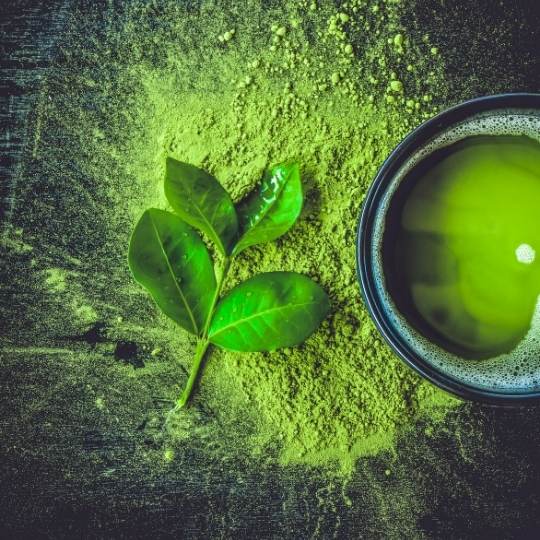
Matcha is a finely ground powder made from the leaves of the tea plant Camellia sinensis, which grew in shade before harvest and after harvest were steamed, dried, stripped of their veins and ground. The Japanese call this intermediate product tencha. The most important distinction is this: ceremonial grade matcha is not an official category in Japan. The term was created by Western sellers to distinguish matcha meant to be drunk on its own, with water only, from cheaper culinary matcha for baking and milk drinks. Quality is therefore not told by the words on the front of the package, but by concrete data: region, harvest, cultivar and grinding date.
Where did the term "ceremonial grade" come from?
In Japan tea houses do not write "ceremonial grade" on their tins. They use the names of their own blends, state the region and distinguish matcha suitable for usucha (thinner, frothed) from matcha for koicha (thick, velvety, prepared from the most delicate powders). It is matcha for koicha that comes closest to what Europeans call ceremonial grade.
The Japanese tea industry association (Nihon Chagyō Chūōkai) has described matcha as powder made from tencha, traditionally ground in stone mills or by a method with a comparable result. For the buyer this leads to a simple conclusion: a green powder from tea leaves picked without shading and ground industrially may taste good, but it is not matcha in the Japanese sense, even if its label says "ceremonial".
From Song monasteries to the tea houses of Uji
Powdered tea whisked with water was drunk in China under the Song dynasty. The custom was brought to Japan by the Zen monk Eisai, who at the end of the 12th century returned from China with tea seeds, and in 1211 wrote the treatise Kissa Yōjōki, "Drinking Tea for Health". In Zen monasteries the drink helped monks stay alert during long meditations. Over time a whole art grew up around the bowl of matcha, chanoyu, which was given its shape in the 16th century by the master Sen no Rikyū. His ideal of wabi means simplicity, humble vessels and attentiveness towards the guest.
In China powdered tea eventually gave way to whole leaves steeped in water, while in Japan it survived. That is why Japanese regions are the point of reference for matcha today, although they are not the only place where it is made. In "The Book of Tea" of 1906, Kakuzō Okakura described this path to the West as a journey from a drink to a philosophy of everyday life.
Country and region of origin: what does a place name really tell you?
EU consumer information rules (Regulation No 1169/2011) require the country of origin to be given when its absence could mislead. With matcha a good seller goes further and gives the prefecture or town. Most often you will meet:
- Uji (Kyoto prefecture): the historic heart of matcha, where the technique of shading tea bushes was developed from the 16th century. Uji matcha is famous for deep umami and a scent reminiscent of freshly cut grass and seaweed.
- Nishio (Aichi prefecture): a region with a huge share of Japanese tencha production, known for stable, finely ground matcha.
- Yame (Fukuoka prefecture) and Kagoshima: the south of Japan, with a warmer climate, often sweeter, fuller profiles and early harvests.
- Shizuoka: Japan's largest tea region, associated mainly with sencha but also producing matcha.
- China, especially the provinces of Zhejiang and Guizhou, and South Korea (Boseong, Jeju): powdered tea is made here too, sometimes very good. A good label simply says so, rather than suggesting Japan with its graphics alone.
"Japanese style" or "Japanese recipe" is not information about origin. If the package carries Japanese script but no country name, it is worth asking the seller directly.
What to read on a matcha package, line by line
The label of good matcha is short but specific. Here are the elements that let you judge a product without opening the tin:
- Ingredients. They should read simply "100% green tea (matcha)". Sugar, milk powder, maltodextrin or flavourings mean a ready-made drink mix, not matcha.
- Harvest. Ichibancha, the first spring harvest (April, May), gives the most delicate leaves, richest in amino acids, including L-theanine. Matcha from the second and later harvests can be more bitter and goes mainly to the kitchen.
- Shading. The bushes are usually covered for about three to four weeks before harvest. A mention of traditional shading (ōishita) or of tencha as the raw material is a good sign.
- Cultivar. Names such as Samidori, Okumidori, Asahi or Yabukita are cultivars, each with a different flavour profile. Naming the cultivar shows that the producer knows their field.
- Grinding method. Stone mills (ishiusu) grind slowly, about a few dozen grams an hour, so the powder does not overheat. Industrial grinding is faster and cheaper. Both are acceptable; what matters is knowing which was used.
- Grinding or packing date. Matcha loses colour and aroma faster than leaf tea. The grinding date tells you more than the best-before date alone.
- Packaging. An airtight tin or pouch with a light barrier, often filled with nitrogen instead of air. A transparent bag is a warning sign.
- Batch testing. A good supplier can confirm that the batch was tested for pesticide residues and contaminants in line with EU limits, for example Regulation (EU) 2023/915.
It is with exactly this data that we describe the ceremonial matcha at Las Szamana. If the description lacks information that matters to you, write to us and we will check it with the supplier for the specific batch.
Colour, scent and price: signals beyond the label
The label is one thing, the senses another. Matcha from a shaded spring harvest has a vivid, bright green colour, sometimes with a hint of jade. An olive, yellowish or greyish powder usually means a later harvest, less shade or oxidation after lying too long. The scent should be fresh, vegetal and slightly sweet. A smell of hay or dust suggests old powder.
Good matcha powder is very fine, feels like talc and leaves a thin layer on the fingers. Umami and gentle sweetness dominate the taste, and bitterness is present but does not overwhelm. Price also says something: slow grinding, hand selection of leaves and the first harvest cost money. A very cheap "ceremonial grade" is usually culinary matcha with better graphics.
Matcha in the rhythm of the day: why rather before noon?
Matcha contains caffeine and L-theanine, an amino acid characteristic of tea, which is exceptionally abundant in shaded leaves. A 2021 review by Kochman and colleagues describes this composition in detail, while noting that content depends on the harvest and processing. Because the whole ground leaf is consumed rather than just an infusion, a bowl usually contains more caffeine than a cup of ordinary green tea.
Hence the simple logic of the clock. In Japanese homes and tea houses matcha accompanies above all mornings and early afternoons, often with a wagashi sweet that balances its bitterness. It is a time for focus, work and conversation. If you like to close the day with a warm cup, reach for a caffeine-free infusion in the evening and keep matcha for the morning. It is best to start with ceremonial matcha whisked with water alone, to get to know its pure taste, and only then reach for the flavoured versions.
Short questions about matcha
Is culinary matcha worse?
Not worse, just different. Its more pronounced bitterness comes through well in milk, cake or ice cream. For drinking with water alone, a more delicate first-harvest powder works better.
How should an opened tin be stored?
Tightly closed, away from light, heat and odours, ideally in the fridge, but before opening wait for the tin to warm to room temperature so that moisture does not condense inside. Opened matcha is best used within a few weeks.
Do lumps in the powder mean a defect?
No. Very fine powder naturally clumps. In tea houses it is sifted through a small sieve before being whisked with a bamboo chasen. It is the first, calm step of the whole ritual.
Is matcha from China a fake?
No, as long as it is clearly labelled. It is simply a different origin and often a different flavour profile. The only problem is hiding the country behind Japanese styling.
If you are pregnant or breastfeeding, or take medication regularly, consult a doctor before use.
Sources
- Kochman J., Jakubczyk K., Antoniewicz J., Mruk H., Janda K., "Health Benefits and Chemical Composition of Matcha Green Tea: A Review", Molecules, 26(1), 85, 2021.
- Okakura K., The Book of Tea, New York, 1906.
- Eisai, Kissa Yōjōki (Drinking Tea for Health), 1211, a text discussed in the historiography of Japanese tea culture.
- Regulation (EU) No 1169/2011 of the European Parliament and of the Council on the provision of food information to consumers: eur-lex.europa.eu
- Commission Regulation (EU) 2023/915 on maximum levels for certain contaminants in food: eur-lex.europa.eu
- Nihon Chagyō Chūōkai (Japan Tea Central Public Interest Incorporated Association), definition of matcha and tencha adopted by the Japanese tea industry, 2019.